Digital money & financial infrastructure
Payments, investing and credit move onto platforms, assets get tokenized, regulation opens crypto to institutional capital. That covers payment networks and fintech, crypto infrastructure and tokenization, digital brokers and wealth platforms as well as traditional banking and insurance software and alternative asset managers. Whoever operates the underlying rails earns on every transaction that runs through the platform — a structurally different business model than a pure software supplier to banks and insurers.
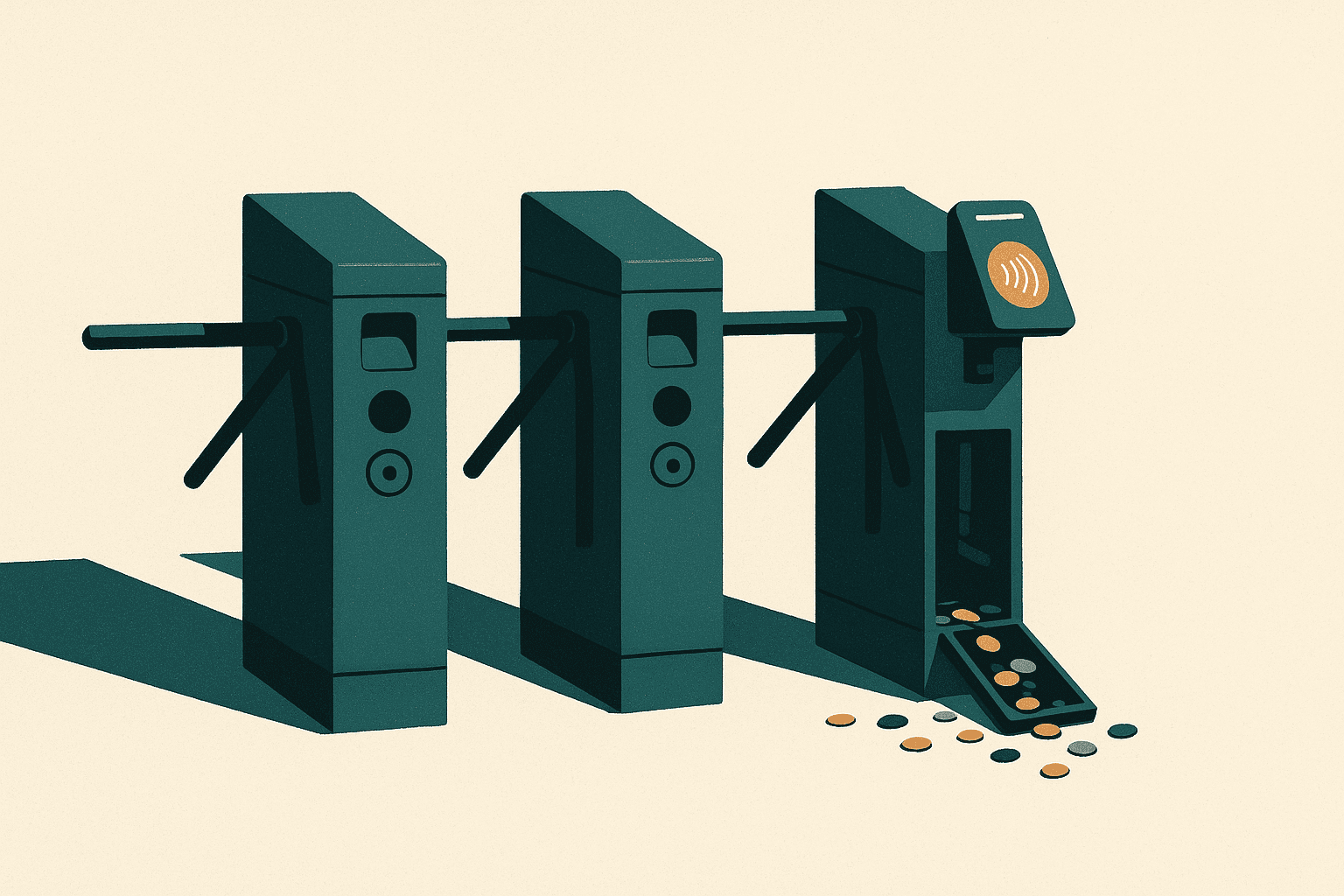
Payment networks & fintech
Every time a card is swiped or an app payment triggered anywhere in the world, the network behind it earns a cut without carrying credit risk itself, a business model with unusually high margin. Because cash and traditional branch banking get used less and less, value creation is structurally shifting away from physical bank infrastructure toward the digital rails money actually flows through.
Kartennetzwerke · Zahlungsabwickler · Digitale Wallets · Buy-now-pay-later · Filialbanken





Crypto infrastructure & tokenization
Regulation that long distrusted cryptocurrencies is increasingly opening up to institutional capital, giving exchanges, custodians and stablecoin issuers an entirely new customer segment beyond retail speculators. At the same time, traditional assets like bonds or funds can be represented as tokens, potentially making trading and settlement faster and cheaper than through decades-old traditional exchange infrastructure.
Krypto-Börsen · Stablecoin-Emittenten · Verwahrung · Tokenisierungs-Plattformen · Mining


Digital brokers & wealth platforms
Investing used to mean high fees and a bank advisor, today apps do it for a fraction of the price, which is pushing especially younger investors to manage their own money instead of trusting it to an advisor. Neobrokers and ETF providers grow structurally at the expense of expensive, advice-heavy distribution models at traditional banks.
Neobroker · ETF-Anbieter · Robo-Advisor · Traditionelle Filialbanken im Wertpapiergeschäft


Banking & insurance software
Behind every bank and insurer sits software that manages accounts, detects fraud and ensures compliance, often systems that have run for decades and now urgently need replacing. Whoever modernizes these core systems wins a customer who, given the complexity and risk of switching, will barely change provider again for many years.
Kernbankensysteme · Compliance- und Betrugserkennung · Versicherungs-Software · Finanzdaten und Indizes


Alternative asset managers
More and more capital from pension funds and wealthy investors flows into private holdings instead of public markets, chasing higher returns and less daily price swings. Managers of these private funds earn fixed management fees over long, often ten-year commitments, regardless of exactly how any single holding ultimately performs.
Private Equity · Private Credit · Infrastruktur-Fonds


