Health & aging society
Aging populations in developed and emerging markets drive demand for therapies, medtech, diagnostics and care, while new drug classes reshape entire disease areas. That spans obesity and oncology drugs through surgical robotics, diagnostics and genomics to elder care, health IT and the contract manufacturers producing behind the scenes. Innovation leaders with patent-protected drugs need to be assessed differently than the broad supplier base that mainly earns from the rising volume of care an aging society requires.
Obesity & metabolic
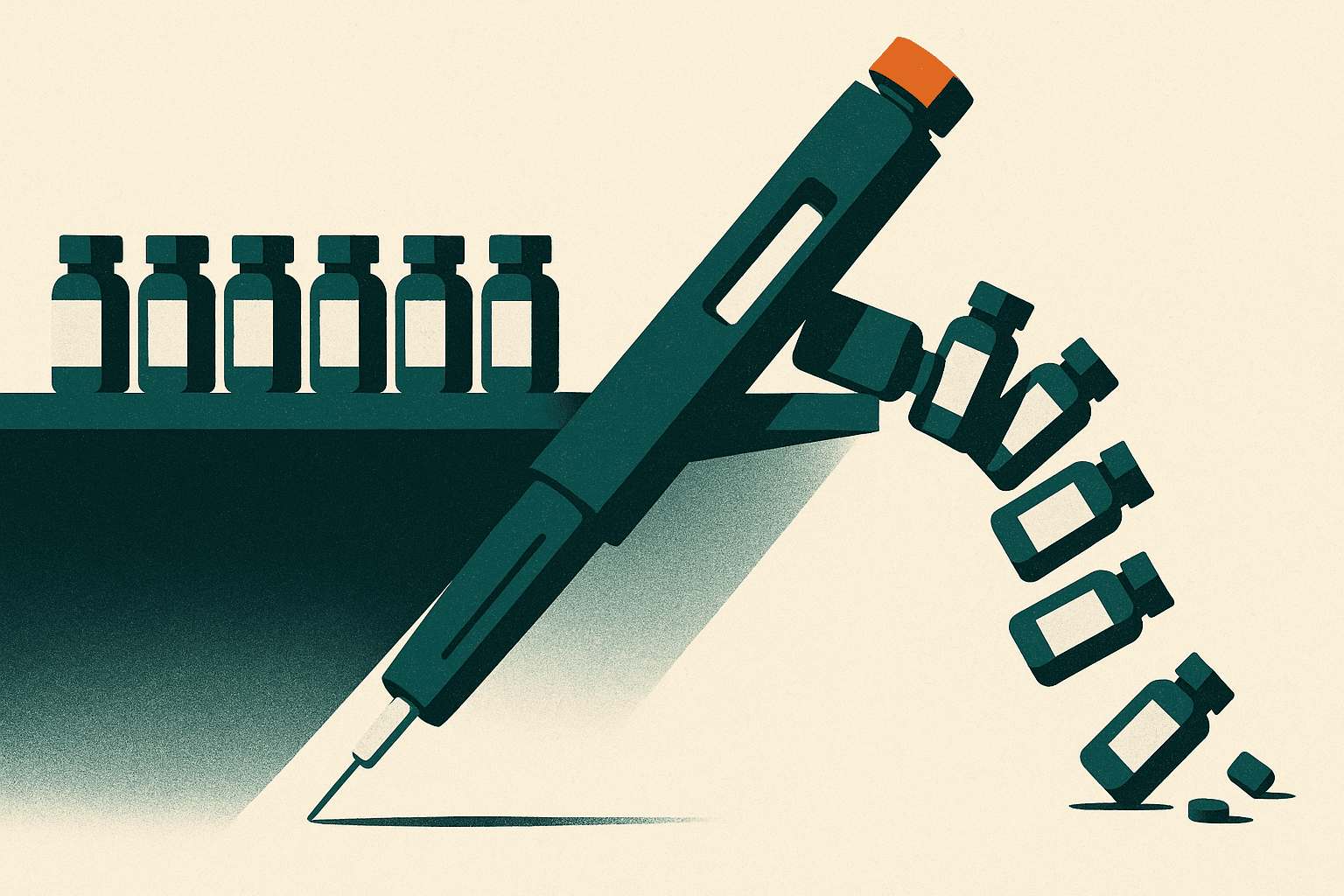
GLP-1 drugs work so well against obesity and diabetes that they are not just a new medicine but are putting pressure on entire adjacent industries like fast food and confectionery. Because demand vastly outstrips manufacturing capacity for peptides and injection devices, specialized contract manufacturers and suppliers earn heavily too, regardless of which company wins the race for the next drug.
GLP-1-Hersteller · Peptid-Auftragsfertiger · Injektionssysteme · Snack- und Fast-Food-Anbieter




Oncology & precision medicine
Cancer treatment is increasingly tailored to the genetic profile of an individual tumor, allowing higher efficacy than classic chemotherapy and letting manufacturers charge correspondingly high prices per treatment. Because every approved precision therapy needs a matching companion diagnostic to identify the right patients, diagnostics providers benefit alongside the pharma makers themselves.
Onkologie-Pharma · Antikörper-Wirkstoff-Konjugate · Zell- und Gentherapie · Begleitdiagnostik




Medtech & surgical robotics
Robot-assisted surgery is more precise and less invasive than classic procedures, which pushes hospitals to switch despite high upfront costs once enough patients and reimbursement justify it. Because older people rely far more often on implants and cardiovascular devices, this market also simply grows with the aging population, independent of technological progress.
Chirurgische Robotik · Implantate und Orthopädie · Herz-Kreislauf-Geräte · Bildgebung




Diagnostics & genomics
Catching a disease early is almost always cheaper and more effective than treating it later, which is why medicine is shifting from treatment toward prevention. Falling gene sequencing costs make broad preventive testing economical for the first time, turning lab diagnostics and liquid biopsy providers into a structurally growing business rather than just a cyclical one.
Sequenzierung · Liquid Biopsy · Labordiagnostik · Point-of-Care-Tests



Elder care & senior living
The baby boom generation is now reaching an age where many need care, a demographic trend that is locked in for decades and cannot be reversed. Nursing home operators, specialized property owners and makers of aids like hearing devices benefit from demand that, unlike most consumer trends, is barely tied to the economic cycle.
Pflegeheimbetreiber · Gesundheits-REITs · Häusliche Pflege · Hörgeräte und Hilfsmittel





Health IT & AI diagnostics
Hospitals still often run on paper records and isolated systems, which invites errors and eats up time that should go to patient care. Software that connects data and uses AI to interpret X-rays or lab results promises noticeably better diagnoses while cutting administrative costs, which is why hospitals keep investing even under tight budgets.
Klinik-Software · Telemedizin · KI-Bildauswertung · Abrechnungs- und Datenplattformen




Contract manufacturing & life-science tools
No pharma company manufactures every active ingredient fully in-house anymore, so contract manufacturers and lab equipment suppliers earn from practically every new drug regardless of which company developed it. That makes them the industry's pick-and-shovel sellers: their revenue depends less on any single drug's success than on the overall pace of pharma innovation.
CDMO · Bioprozess-Ausrüstung · Laborgeräte und Verbrauchsmaterial · Klinische Forschungsdienstleister